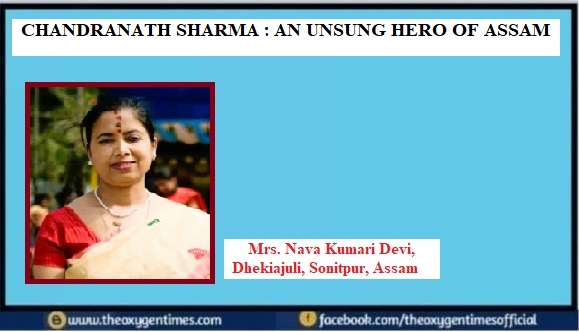
Introduction:
Karmabir Chandranath Sharma, born on December 9, 1889, in Mekonor Chuburi, located in the then Darrang district (now Sonitpur district) of Assam, hailed from a humble background. Despite his modest beginnings, Sharma emerged as a prominent and highly respected figure, earning a range of titles such as "Karmabir," "Pit Chandra," "Agni Kalyan Ashahogoi," "Intellectual," "Editor of Alochoni," "Poet," "Social Reformer," "Social Organizer," and "Literary Figure." These epithets highlight his exceptional contributions to society across various domains—social, political, and cultural development. He was a towering personality in early 20th-century Assam, widely recognized for his selfless commitment and professional expertise. His life was marked by a distinctive combination of fearlessness, integrity, deep compassion for the common people, and an unwavering love for his homeland, which set him apart as an extraordinary individual. Above all, he was a true patriot, motivated not by personal fame or wealth but by a profound sense of duty to his country. During his lifetime, significant movements like the Assam Student Union, Assam Literary Union, and Assam Association were emerging, all of which played a pivotal role in preserving the language, literature, culture, and traditions of the Assamese people. Sharma, with his strong sense of responsibility toward his homeland, became a central figure in these organizations. His unwavering dedication to social and political progress made him an influential personality in Assam’s awakening.
Chandranath Sharma exemplified the qualities of a karmayogi—a person dedicated to the path of action. His guiding principles were twofold: first, "The body dies every moment and will continue to do so until it perishes completely; therefore, do something worthwhile while alive." Second, "One can achieve far more by acting not for their own happiness, but for the happiness of others."As a social reformer, Sharma worked relentlessly to dismantle the divisive caste system. He played an instrumental role in establishing national schools to promote education, forming panchayats to advance societal progress, and advocating for the rejection of intoxicants. His tireless dedication to these causes was unmatched, and his life stood as a testament to hard work, sacrifice, and a deep commitment to societal betterment. Sharma’s relentless efforts earned him the admiration of many, including Gopinath Bordoloi, who praised him as "a dedicated and relentless worker of the new youth movement." Bordoloi further acknowledged Sharma's selfless contributions in sustaining the spirit of this awakening. Despite his intense commitment to his work, Sharma's life was tragically cut short at the age of 32 years and 6 months. Yet, in his brief life, he made significant contributions to his countrymen, earning him the title of "Karmavir."
Educational and literary works:
Chandranath Sharma was a central figure in Assam's literary and cultural movements, deeply committed to safeguarding the language, literature, culture, and traditions of the Assamese people. He played an influential role in significant events such as the Assam Chhatra Sammilan, Assam Sahitya Sammilani, and the Assam Association, all of which were crucial in advocating for the preservation of Assamese heritage. Sharma's passion for literature began in his student years, where he became an executive member of the Assam Literary Conference (later known as Assam Sahitya Sabha), founded in December 1917. While studying at Cotton College, he contributed regularly to journals like Alosoni (Dibrugarh), Asam Banti (Tezpur), Usha, Asam Bilasini (Jorhat), and Chetana (Guwahati). His literary pursuits were greatly influenced by his mentor, Rai Bahadur Padmanath Gohain Boruah. Sharma dedicated himself to preserving the legacies of journals like Asam Banti and Usha, writing on various subjects including the thoughts of Vidyasagar, the significance of mother-tongue education, the Bengali language, Assamese script reform, and the importance of student scholarships. Sharma published four books: Basaphul, Basaphulor Karoni, Vidyasagar, and Metriculation Translation and Composition, each contributing significantly to Assam's literary landscape.He was also a key participant in a linguistic debate between Lakhminath Bezbaruah’s Bahi and Padmanath Gohain Boruah’s Usha, aligning with Gohain Boruah. Bezbaruah famously referred to him as the Asomiya Pit (Father of Assamese), a title that became widely associated with Sharma. From his college years, Sharma championed Assamese literature, viewing it as a movement for social and cultural advancement. Sharma’s involvement in the formation of the Assamese Students' Literary Conference on December 25, 1916, in Guwahati was a turning point in Assam’s cultural history. Under his leadership as the president of the reception committee, the conference was a success. His tireless efforts were recognized by Dandinath Kalita, who described him as an unparalleled figure in Assamese society. Sharma's dedication was so intense that he reportedly neglected food and rest to ensure the success of the event. The conference laid the foundation for the formation of the Assam Students' Conference and, later, the Assam Sahitya Sabha in 1917, where Sharma became its first executive member, continuing his involvement in cultural and literary activities.
By 1918, Sharma was appointed assistant secretary of the Assam Association and, by 1920, served as president of the Reception Committee for the Tezpur session. His work was highly regarded by Acharya Prafulla Chandra Ray, who encouraged students to follow Sharma’s example. Sharma also played a significant role in shaping national education policy. In an article published in Assam Bilasini on March 17, 1921, he proposed a national education scheme, inspired by the visions of 19th-century reformers. He advocated for a three-tier educational system—primary, secondary, and higher education—focused on the mother tongue in primary education. Sharma's curriculum placed emphasis on practical skills such as farming, weaving, tailoring, and carpentry, alongside subjects like geography, history, ethics, and literature. His vision aimed to develop a self-reliant and economically strong nation. It also included the integration of religion, music, sports, and physical education, alongside skills training in agriculture, livestock, and fisheries. Had Sharma’s educational model been implemented, it could have significantly transformed Assam’s education system, fostering a generation of responsible, skilled, and patriotic citizens. However, the lack of moral education at the primary level remains a challenge that continues to have adverse effects on society. If his model had been adopted, many of the social issues faced today could have been mitigated. In conclusion, Chandranath Sharma’s contributions to literature, education, and the preservation of Assamese heritage were fundamental in shaping Assam's cultural and intellectual development. His lifelong dedication to these causes remains an enduring inspiration for future generations.
Prominent role in freedom struggle:
Chandranath Sharma was a key figure in India’s freedom struggle, known for his deep commitment to nationalism and his contributions to the independence movement. Inspired by leaders like Haliram Dhekial Phukan and Peoli Phukan from an early age, Sharma’s nationalist sentiments were further galvanized by events like the Jallianwala Bagh massacre and the introduction of the Rowlatt Act. He became a pioneer of the non-cooperation movement in Assam, playing a critical role as the assistant secretary of the Assam Association, which was established in 1903. The Assam Association merged with the Assam Provincial Congress in 1921, marking a significant turning point in Assam’s political history. Sharma, greatly influenced by Mahatma Gandhi, adopted simple living, often dressing in a dhoti, banyan, and kamij, and after becoming a Purna Asohojogi, he would walk barefoot. Due to his austere lifestyle and principles, he was affectionately known as ‘Asomiya Gandhi’ by the people.Sharma was one of the founding members of the Assam Association, which primarily opposed the British government's increased land revenue under the Assam Land Tenure Bill. The association also advocated for more power to local bodies, the establishment of schools and hospitals, the prohibition of opium, and greater representation of Assamese people in higher administrative positions. In 1918, during the association’s session in Goalpara, Sharma served as assistant editor alongside editor Tarunaram Phukan.In 1919, when the Montagu-Chelmsford Reforms were introduced, Sharma quickly realized that the British administrators were conspiring to keep Assam excluded from the reforms. As secretary of the Assam Association, he submitted a memorandum to protest this exclusion, which led to the association sending two representatives, Nabīn Chandra Bordoloi and Prasanna Kumar Baruah, to testify before the British Parliament. Sharma’s efforts to raise funds for their trip were monumental, with even small donations contributing to the cause. Bordoloi’s presentation in Britain was instrumental in securing Assam’s recognition as a province with equal status to other provinces in India. Sharma’s political awareness grew stronger, especially after realizing the imperialistic motives behind Assam’s exclusion from the reforms. In 1920, Mahatma Gandhi launched the Non-Cooperation Movement in India, and Sharma played a vital role in propagating this movement in Assam. Despite battling fever, Sharma delivered the editorial report at the annual session of the Assam Association in Tezpur, and soon after, he became active in establishing a provincial branch of the All India Congress in Assam. He understood that for the freedom struggle to succeed, it was crucial to establish Congress committees at all levels in Assam, laying the groundwork for the movement’s success in the region.
Recognizing the importance of student involvement in the Non-Cooperation Movement, Sharma encouraged Assamese students to leave their colleges and join the movement. He led a group of students to the All-India Collegiate Students’ Conference in Nagpur in 1920, and upon returning to Assam, he inspired students to take part in local resistance efforts. The involvement of Assam’s students became a key aspect of the movement’s success, and their dedication was praised by the All-India Congress Committee, with Raja Gopalachari recognizing their contributions as essential to India's independence struggle. Sharma’s efforts led to the formation of the Assam Pradesh Congress Committee in 1921. He worked alongside prominent leaders like Kuladhar Chaliha, Nabindra Chandra Bordoloi, and Tarun Ram Phukan. Together, they invited Mahatma Gandhi to Assam, and in August 1921, Gandhi visited the region. Sharma played a crucial role in organizing this visit, ensuring that it had a lasting impact on the state’s political landscape. He placed great importance on leadership in the movement, preferring to let others, like Phukan and Bordoloi, take the lead while he worked behind the scenes to ensure success. During the Non-Cooperation Movement, Sharma traveled extensively on foot, organizing meetings and recruiting workers, often without any prior arrangements for accommodation. His commitment was unwavering, and his ability to carry the message of the movement to remote parts of Assam was a testament to his dedication. On one occasion, he even traveled with Mahatma Gandhi, attending every one of his meetings and delivering speeches.
However, the strain of his tireless work took a toll on his health, and he was diagnosed with tuberculosis. In early 1922, while resting in Puri, Sharma learned that Gandhi had called off the Non-Cooperation Movement due to the violence in Chauri Chaura. Deeply disappointed, Sharma sent a strong protest letter to Gandhi, expressing his belief that the movement should not have been halted because of the actions of a few individuals. In a personal letter to his friend Durganath Baruah, Sharma expressed his concerns about Gandhi’s approach, suggesting that his idealistic interpretation of non-violence could hinder the pursuit of independence. Gandhi, despite the criticism, appreciated Sharma’s forthrightness, and when he heard of Sharma’s death, he referred to him as a “great patriot.” Chandranath Sharma’s contributions to India’s independence movement, especially in Assam, are remembered as pivotal in shaping the region’s political and cultural consciousness during a critical period in India’s struggle for freedom.
Conclusion:
Chandranath Sharma Deb was a remarkable figure — a writer, patriot, and dynamic politician whose absence would have left a void in Assam's political landscape. In today's world, individuals like him are rare. He devoted his life entirely to his country and people, putting aside personal considerations, including his family, to focus solely on freeing his homeland from British rule. Despite facing poverty, he always prioritized the well-being of the marginalized, transcending caste, creed, and religion in his love for the people and his nation. Karmabir Chandranath Sharma’s life was defined by relentless dedication to the nation's welfare. Comfort and idleness had no place in his life; each day was a battle to move forward, and he relentlessly pursued a wide range of goals, from advancing language and literature to fighting for political change. His brief life was filled with significant contributions, achieving the seemingly impossible. Sadly, suffering from tuberculosis, Karmabir Chandranath Sharma passed away on July 20, 1922, at the age of just 32, in the home of his friend Girish Sharma in Shillong. Despite his untimely death, his deep love for the country, tireless enthusiasm for his work, and unwavering commitment to Indian independence make his patriotism exceptional, not just in Assam, but throughout India.
To honor his legacy, the community of Bihaguri has established several institutions, including the Karmabir Chandranath Sharma Smriti Bhawan, Chandranath Sharma Higher Secondary School, and the Bihaguri Karmabir Chandranath Sharma Sahitya Sabha. Additionally, the Nandan-Kanan Music School presents the "Karmabir Chandranath Sharma Award" to distinguished individuals, continuing his message of service to the nation. Chandranath Sharma was a rare soul whose actions not only brought vibrancy to his own life but also left enduring contributions to society. Though his physical absence remains, his ideals and sacrifices continue to inspire future generations to love and serve their motherland. His extraordinary efforts for the nation have immortalized him as one of its great figures.
References
- Golden jublee celebration (2008). SWARNA-CHANDRIKA . Editor: Sri Upen Chandra Nath and published by Golden Jublee celebration committee, Bihaguri,Sonitpur, Assam.
- Golden jublee Celebration (2009). Swarnalipi. Published by: Mukul Chutia, Principal & Secretary, Golden Jublee celebration committee, Chandranath Sharma HS School, Sonitpur, Assam.
- Nath, Biswajit (2022). Pathikrita. Karmaveer Chandranath Sarmah Mritu Satabarsha Xuworan Samitee.